


In the previous post, we discussed the Singly Linked List and the operations that we can perform it. Here we are going to discuss the insertion of new nodes in a singly linked list in detail.


Output:
There are three ways of inserting a new node into a Linked List and these are,
- Adding a node at the beginning of the list.
- Adding a node after a given position in the list.
- Adding a node at the end of the list.
Structure of our node using C++ class:
class Node{
    public:
    int data;
    Node *next;
    //constructor
    Node(int data){
        this->data = data;
        this->next = NULL;
    }
};
1. Adding a node at the beginning of the Linked List.
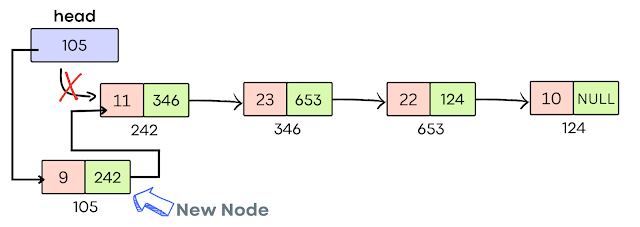
A head pointer is used in the linked list that always points to the first node of the list and when we add a new node in front the new node becomes the first node and now the head pointer should point to this new node. You can follow the below three steps to add a new node at the front of the list.

- Create a new node and store the data value in the first part of the node and the second part is initially pointing to NULL.
//create a new node and initialize data value using constructor
Node *new_node = new Node(data);
- Point the next pointer of the newly created node to the existing first node whose address is present inside the head pointer.
new_node->next = head;
- Update the value of the head pointer with the address of our new node as the head always points to the first node of the list.
head = new_node;
2. Adding a node at a position in the Linked List.
You can follow the below steps to insert a new node at a specified position in the Singly Linked List.

- Traverse the given list and reach the position-1 node and mark that node as current.
- Create a new node with the given data value and the next pointer initially pointing to NULL.
- Point the next pointer of the new node to the next of the current node.
- Point the next pointer of the current node to the newly created node.
3. Adding a node at the end of the Linked List.
This is the most common way of adding a new node to the list because whenever we create a new node we prefer to add it at the end of the list. You can follow the below steps to add a new node at the end of a singly linked list.

- Traverse a given list using a temp pointer till you reach the end of the list.
- Create a new node with the given data value and the next pointer of the new node pointing to NULL.
- Point the next pointer of the temp node to the new node and the next pointer of the new node is already pointing to NULL.
Complete C++ program of Inserting a new node in a Singly Linked List.
//C++ Example of Insertion in Singly Linked List
#include<iostream>
using namespace std;

class Node{
    public:
    int data;
    Node *next;
    //constructor
    Node(int data){
        this->data = data;
        this->next = NULL;
    }
};

//Add a node to the front of list
Node *insertFront(Node *head, int data){

    Node *new_node = new Node(data);
    //add a new node when list is empty
    if(head == NULL)
      head = new_node;
    //adding new node at the front of the list
    else{
        new_node->next = head;
        head = new_node;
    }
    return head;
}
//Add a node after the position
Node *insertPos(Node *head, int pos, int data){
    int count = 0;
    Node *current = head;

    //Adding a node in empty list
    if(current == NULL){
        Node *new_node = new Node(data);
        head = new_node;
    }
    //Adding a node after given position
    else{
        while (count != pos-1)
        {
            current = current->next;
            count++;
        }
        Node *new_node = new Node(data);
        new_node->next = current->next;
        current->next = new_node;
    }
    return head;
}
//Adding node at the end of the list
Node *insertEnd(Node *head, int data){
    //create a new node
    Node *new_node = new Node(data);
    Node *temp = head;
    //when list is empty
    if(temp == NULL){
        head = new_node;
    }
    else{
        while (temp->next != NULL)
        {
            temp = temp->next;
        }
        temp->next = new_node;
    }
    return head;
}

//Traversing Linked List
void display(Node *head){
    Node *temp = head;

    while(temp != NULL){
        cout<<temp->data<<" ";
        temp = temp->next;
    }
}

int main(){
    Node *head = NULL;
    head = insertFront(head, 10);
    head = insertFront(head, 13);
    head = insertEnd(head, 22);
    head = insertEnd(head, 23);
    head = insertFront(head, 33);
    head = insertPos(head, 3, 32);

    cout<<"Singly Linked List: ";
    display(head);
    return 0;
}
Singly Linked List: 33 13 10 32 22 23- Time Complexity: Adding a node at the front of the list takes O(1) time whereas adding a node at the end or in between the list takes O(n) time in worst cases.
- Space Complexity: No extra space is required to perform any insertion operation so space complexity will be O(1).


