How To Turn any Folder into a Drive using Windows Command Prompt.

Virtual Drive

Windows only recognize partitions or physical drives as separate drives. However, using the ‘subst’ command you can turn any folder into a virtual drive that shows up with its own drive letter in File Explorer.

This is useful if, for example, you have a folder with specific types of files, such as pictures, or videos that you want to treat as a separate drive, for example. It also helps you to manage your files better in Windows PC.

To do this, type subst, followed by the drive letter you want to use, then the path of the folder. So typing subst G: C:\Users\Username\Videos (replace Username with your Windows account name) will create a virtual drive dedicated to hosting the contents of your Videos folder.  

Virtual Drive


If you want to remove the virtual drive, simply type subst, followed by the drive letter, then the /d switch-so, in my example above, typing subst G: /d will remove the virtual drive, but the contents will remain intact in its original location (C:\Users\Username\Pictures in this case).

How To Open Your WiFi Router’s Settings .

Router Settings.

There are so many changes that you can make through router’s settings like changing your network name, changing network password, creating a guest network, changing security settings, and many other options.


The process for accessing your router’s settings is the same for most makes and models, but there are some exceptions. In most cases, you just type the relevant router-settings address (or the router’s IP address) in your web browser. This can usually be found somewhere on the router itself (check the underside) or in the manual.

Find the Router’s IP Address.

192.168.1.1 is the IP address of most of the routers but it is not the same for all. You can confirm your router’s IP address using Windows Command Prompt.

Press Windows key, type cmd in the search box, and press Enter. Inside Command Prompt Window, type ipconfig and press Enter.

ipconfig


Scroll through the result until you find an entry named ‘Default Gateway’ and the number listed next to it is your router’s IP address.   

Router IP

You can try connecting to your router via HTTPS rather than HTTP (https://192.x.x.x.) because this is more secure, but you may find the protocol isn’t supported by less security-conscious manufacturers.

Find Wi-Fi Router’s Password. 

The username and password you need to log in should be printed there on the router itself unless you’ve already changed these details.

If you have never changed the router’s login detail, they will be ‘admin’ for username and ‘admin’ for a password. These are the default username and passwords for all routers but you should change the default admin password of your router.

If you are not going to change the default password, then someone can easily walk up to your router settings and can access your personal information without you knowing about it.

Suppose, In case, you have changed the router default password and now you don't remember your WiFi router password then you can refer to my blog post on how to recover forgotten WiFi passwords. In that post, I have explained how you can check your wireless network name and recover your password using Windows Command Prompt.

Different Router’s IP Address example.

For example, the address for Virgin Media’s Super Hub is http://192.168.0.1 or 192.168.100.1, if you’re using Modem Mode). You’ll find detailed instructions for it at bit.ly/vhub468.

For BT’s Smart Hubs, the address is 192.168.0.1, and TalkTalk’s Wi-Fi Hub settings can be accessed at 192.168.1.1.

Some standard IP addresses are:
  • Apple: 10.0.1.1
  • ASUS: 192.168.1.1
  • Belkin: 192.168.1.1 or 192.168.2.1
  • D-Link: 192.168.1.1 or 192.168.0.1
  • Linksys: 192.168.1.1 or 192.168.0.1
  • Netgear: 192.168.0.1 or 192.168.0.227

How To Remove Duplicate Files on Windows 10 PC.

Duplicate file.

Duplicate files on your PC do nothing except consuming hard drive space and making the PC slower. It is easy to inadvertently accrue a vast number of duplicate files-copies of photos, music tracks, videos, documents, and so on.

You can use Duplicate File Finder to search and remove multiple instances of identical items, and the best part of this tool is that it can find duplicate files even if they have different names. It is also capable of removing duplicates from Cloud-storage services like Google Drive and Dropbox.

By default, it searches the main folder on your PC (Desktop, Documents, Music, Picture, and Downloads), but you can specify custom folders if you wish, and have the program skip small files (under 100KB), which are unlikely to be of interest.

Find Duplicate Files and Remove them from Windows.

Download Easy Duplicate Finder for Windows and install it on your computer.

After the installation is complete, open the application and scan the hard drive or SSD using File Search mode.

Duplicate Files Finder.


The scanning process may take time depending upon the number of files your computer hard drive have.

Search Duplicate File.


Once Duplicate File Finder has scanned your system, the program presents its findings. When you’re ready, select your file management preference or click a button to automatically move your duplicates to the trash.

Remove Duplicate Files.


If you accidentally delete those files that you don’t wish to delete, then you can use the “Undo” feature of the app to recover those files.

How To Schedule or Draft Your Tweets from Twitter Web App.

Twitter

Twitter now allows users to schedule tweets right from the Twitter web app to send at a specific time. Now users can also save draft tweets to post them later.

Twitter had originally said it was “experimenting” with the feature back in November, and if you didn’t get access to that feature, you can use Tweetdeck or another third-party service that supported this schedule tweets feature.  

Schedule Tweets to send at a specific time. 

Twitter recently launch Schedule Tweets option to post any tweet at a specific time. However, this feature is only available from the Twitter web app. To use this feature:

Open your Twitter account on the web and compose a tweet, you can see a little calendar icon on the bottom row of icons of the tweet window.

schedule tweet option.


Click on that calendar icon, now you can set Date, Time, and Time zone for scheduling your tweet to send at a specific time. Click on Confirm to save.

Set schedule time and date.


You can also see all scheduled tweets by clicking on the ‘Schedule Tweets’ option from that window. 

Save Draft Tweets on the Twitter desktop. 

Before, the save draft tweets feature was only available on Twitter's mobile app and now you can use this feature on the Twitter web app too.

To use this feature, open your Twitter account on your favorite browser on your PC. Open the Tweet window to write your tweet which you want to save as a draft and click on the cross mark to close the window.

Save Draft Tweet.


A pop-up will appear asking you that you want to save the tweet as a draft or discard it completely. Click on Save.

To reopen your draft tweets open the Tweet window (see image for better understanding) and click on the 'Unsent Tweets' option in the upper-right corner of the window.  


How To Clear Microsoft Store Cache to resolve problems in Windows 10.

Microsoft Store.

If you notice you can’t install or update apps from the Microsoft Store, then there’s likely to be a problem with the Store’s app cache.

Today in this post we are going to look into the different ways by which we can clear Microsoft Store’s cache to resolve these problems without deleting any installed apps.

There are two ways to clear this cache and resolve the problem. 

Clear Microsoft Store Cache with WSReset.exe

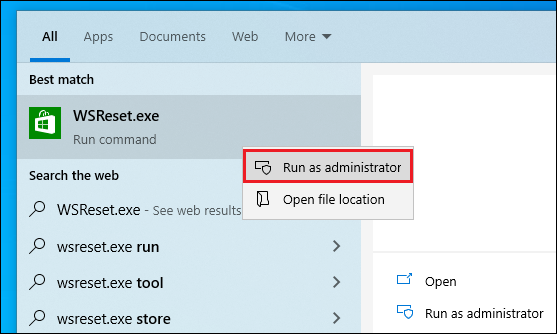
First, click on Start (Windows Key) and search for WSReset.exe using the search box, then press Enter. Right-click on the result appear and select ‘Run as administrator’.

WSReset to clear cache.


An empty Command Prompt window will open and the cache will then be emptied. Once the cache is cleared, this window will close and the Microsoft Store will open on your desktop.

WSReset.exe


Now try to update any present application or try to install any new one to check that it is working fine or not. If this doesn’t resolve the problem, then try the second method. 


Clear Microsoft Store Cache using Registry Editor.

In this process, we are going to use Windows 'Registry Editor' to clear Microsoft Store Cache. To do this:

Press the Windows key, type cmd in the search box, right-click the 'Command Prompt' option, click ‘Run as administrator, then click Yes.

Windows CMD as administrator.


Now type the following command into the Windows Command Prompt: whoami /users (see image), press Enter, then minimize your Command Prompt window.

USER INFORMATION in CMD.


Next, type Regedit into your Windows search field, open your Registry Editor and navigate to the following key: HKEY_LOCAL_MACHINE\SOFTWARE\Microsoft\Windows\CurrentVersion\Appx\AppxAllUserStore.

Registry Editor.


Important: As the next step involve tweaking the Windows registry so it is good to create a backup. To create a backup of the registry, click on File, then Export.

Backup Registry File.


Next, maximize your Command Prompt window again. You’ll see a long value beside your user account name, which should correspond to a folder name under the 'AppxAllUserStore' heading in your Registry Editor.

Clear Cache using Registry Editor.


Search this matching folder name and delete this folder in your Registry Editor (it contains your Windows Store cache). Restart your PC.  

So, these are the two different processes by which you can clear Microsoft Store Cache to resolve app updates or installation problems. If you face any problems during the process, ask me in the comment section below. 

How To Preview Google Chrome Search results.

Preview the Google search results.

Apart from promoted content and ads on top of the search result, position 1 and position 2 web page link contains the most relevant information to your quire, and Google also shows a small description below the search result for you to check whether the inside information is useful to you or not.

People mostly open few top search results in new tabs and start looking at each tab one by one to get the best information and I guess you also do the same but what if Google gives you an option to preview the search results without clicking on any link.  

Preview the Google search results.


There is no official feature in the Google Chrome web browser to preview the search results but you can use an interesting Chrome extension to do so.

Open your Chrome browser and search for Google Results Preview Extension in Chrome Web Store. Click on ‘Add to Chrome’ to download and install that Chrome Extension.

Google Results Preview Extension.


Now, click on the extension icon on the top right corner of the browser and tap on “Turn Results Preview On” and then the extension icon will turn into a free ON icon.

Trun of Preview Extension.

Now search for something on Google then hover your cursor over any of the results to see a large preview. You can even scroll through the preview page without ever leaving Google. 

Google Search Results Preview.


Preview takes a couple of seconds to appear, but it’s a lot quicker than loading the entire page to discover it’s not what you wanted. You can stop preview loading by clicking anywhere on the blank space.  

You also get three additional options below the preview windows, one arrow sign to ‘open link’ that page then the next option to ‘copy the link’ of that preview page, and the last one is about us. 

This is one of the most interesting and useful extensions I ever found, as it saves a lot of time while browsing and looking for the relevant information on different pages.  

How To Tag your Files with Keywords on Windows to find files faster.

Tag Files in Windows 10

Searching a file on Windows is a time taking process and sometimes the Windows search box also fails to help us. Although there are many ways to search your files faster in Windows 10 the best way is to keep your files organized from the beginning by adding “tags” to a file.

You can add ‘keyword tags’ to files for easy organization and later it will help you in searching those files using the tags keyword. For example, you have files (including documents and photos) related to vacation. In that case, adding the tag ‘holiday’ to any related file will group it in the search results for that keyword.     

Tags Files with Keywords in Windows File Explorer.


I am going to use my download folder for an example, as files in this folder belong to nowhere.

Get started by right-clicking the file you want to tag (or select a group of files and right-click one to change the tags on all of them simultaneously) and select Properties from the menu.

Tags Files in Windows 10.

Click the Details tab, then double-click the blank space next to "Tags", below the Value header. Type your tags with a semicolon between each one and press Enter after the last one. You can use any character and even it allows spaces if your ‘tag keyword’ contains two words.


Unfortunately, tagging isn’t available for all file types, so if the Tags option isn’t visible on the Details tab, you’re out of luck. However, it does work on Office documents and it’s a feature we’d like to see Microsoft build on in the future.

Use Tags to find files faster in Windows 10


After adding a tag to some of the files, you can use those tags for searching that file in the Windows search. Tags work in different ways depending on where you are searching for the file.

Suppose, you are inside the folder which contained the file, then you can simply type tag keyword in the search box to get the file. Sometimes, search results also include those files whose name contains a similar text.

Search a tag file on Windows 10


If you are searching the entire PC for the file then you have to use “tags:” operator before the name of the tag keyword in the search box of Windows File Explorer.

Searching file in Windows


You can also apply “tags” operator from Search, Other Properties, and then click on Tags. It is mainly useful to narrow down your performed search result. 
Apply Tags to Windows Search

You can also remove or edit the tags of the file by following the same process as explained above.  

How To Connect Your Amazon Echo to a Bluetooth speaker or headphone.


As we all know, Amazon Echo is a smart speaker that you control with your voice and it is connected to the Alexa voice assistant who listens to your voice commands and performs services like, play music, ask a question, make a call, send and receive messages, provide information related to news, sports, weather and many more. You can also check my post on useful voice commands for Amazon Echo. 

Now, if we talk about Amazon Echo sound quality, it isn’t bad but it is not that loud and you won’t be able to hear it from another room. I prefer listening to loud music Echo speaker is not enough for me so I use to connect my Bluetooth speakers with it for better sound quality.

If you also want to connect your Amazon Echo with nearby Bluetooth devices and headphones, which may have better quality speakers then you can follow the steps explained below.

Connect Bluetooth Device with Amazon Echo.

  • At first, put your Bluetooth device into pairing mode, then open the Alexa app.

  • Tap Settings, then find and tap Device Settings.
Connect Amazon Echo to Blutooth Device


All devices with Alexa built in-including Echos, Fire devices (tablets, TVs, and more), and your phone-appear in a list.
  • Select the Echo device you want to pair from the list.

  • Under Wireless, tap Bluetooth Devices.
Connect Amazon Echo with Bluetooth Device

  • On the next, screen, tap the ‘Pair a New Device’ button.

  • All compatible Bluetooth devices within range appear in a list.

  • Select the one you want to use and complete the pairing process.

Bluetooth Device list

Note: Make sure that the Bluetooth device that you want to connect is not already connected with another device.

Once that’s done, you’ll be able to select the device you require in the future directly from the app’s Bluetooth Settings screen. Or you can simply use a voice command, “connect my speaker” and Alexa will automatically pair with the last Bluetooth device connected to Echo. You can also use the web app at alexa.amazon.com.

DON'T MISS

Tech News
© all rights reserved
made with by AlgoLesson